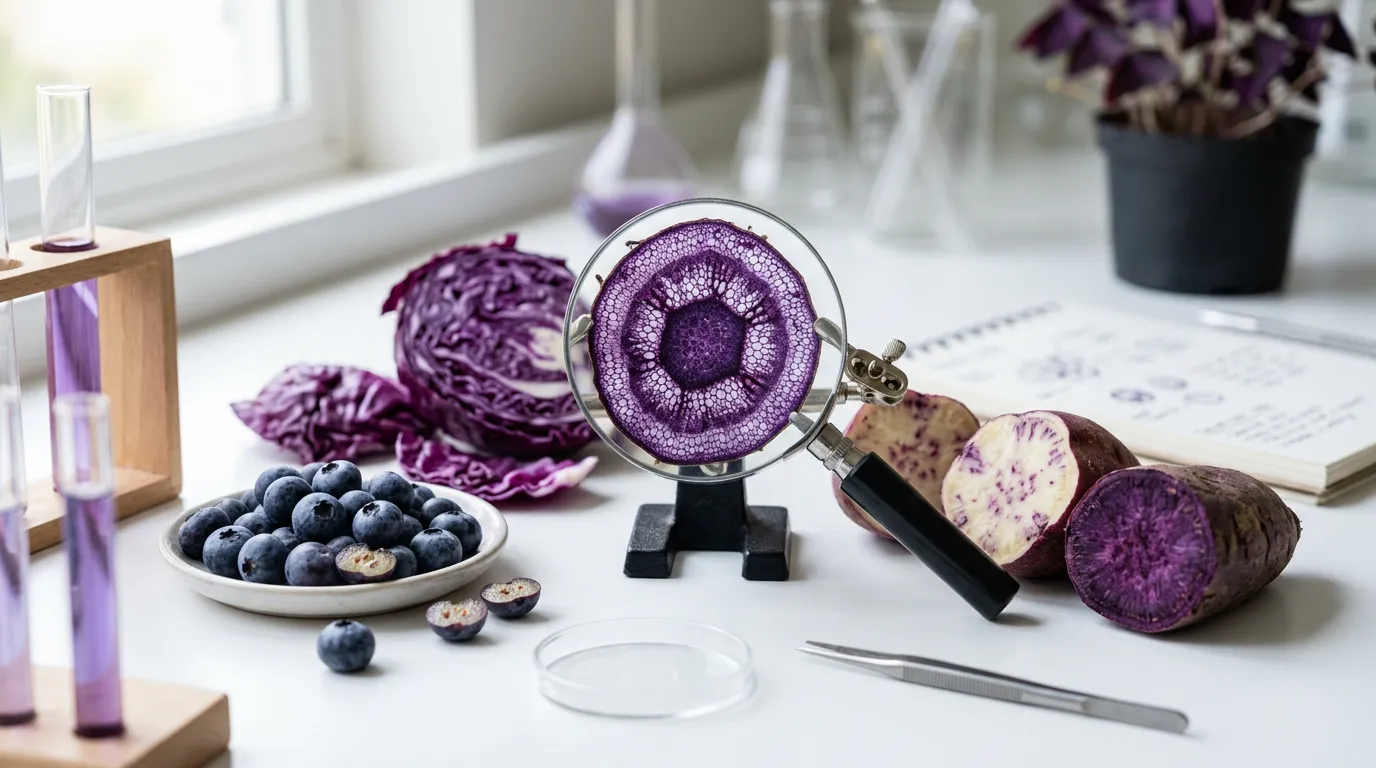
Colour in the plant kingdom is never arbitrary. The pigments that give leaves, flowers, fruits and roots their characteristic hues are biologically active compounds whose production is metabolically costly and whose presence reflects specific ecological functions shaped by millions of years of natural selection. Chlorophyll greens signal photosynthetic activity. Carotenoid yellows and oranges attract seed dispersers and protect photosynthetic machinery from excess light energy. The anthocyanins that produce the reds, purples, blues and violets seen across the plant kingdom serve a range of ecological functions whose complexity botanists are still unravelling, while simultaneously representing some of the most biologically active compounds in the human diet.
The global distribution of anthocyanin-producing plants spans virtually every ecosystem on earth, from the blueberries of North American boreal forests to the purple yams of Southeast Asian tropical agriculture, from the red-leaved autumn trees of temperate deciduous forests to the anthocyanin-rich succulents of arid environments. Understanding what anthocyanins are, why plants make them, and what they do in human biology connects plant ecology to human nutrition in ways that have significant implications for both conservation and health.
The ube yam, explored in detail in our guide to Philippine plant biodiversity, is one of the most anthocyanin-rich food plants known, with a pigmentation profile that represents the product of both natural selection and generations of human cultivation selecting for colour intensity.
The biosynthesis of anthocyanins and why plants invest in them
Anthocyanins are members of the flavonoid family of secondary metabolites, compounds produced by plants through metabolic pathways that divert resources from primary metabolism to serve ecological rather than directly nutritional functions. The anthocyanin biosynthesis pathway begins with phenylalanine, an amino acid, and proceeds through a series of enzyme-catalysed reactions to produce the core anthocyanidin structure, which is then modified by glycosylation and acylation to produce the stable anthocyanin compounds found in plant tissues.
The ecological functions of anthocyanins in plants are multiple and sometimes apparently contradictory, reflecting the fact that the same pigment can serve different purposes in different tissues and at different developmental stages. In flowers, red and purple anthocyanins function as pollinator attractants, targeting the colour vision systems of bees, butterflies and hummingbirds that associate these colours with nectar rewards. In fruits, anthocyanins serve a similar function, attracting seed dispersers by signalling ripeness and nutritional value to birds and mammals with colour vision.
In vegetative tissues including leaves, stems and storage organs like yam tubers, the functions of anthocyanins are more varied. Protection from ultraviolet radiation is one of the most consistently documented functions: anthocyanins absorb strongly in the UV-A and UV-B ranges and shield underlying photosynthetic tissues from radiation damage in high-light environments. This UV-protective function is particularly important in high-altitude plants, young leaves before the development of full photosynthetic capacity, and plants exposed to intense tropical sunlight, conditions that characterise the growth environment of ube in the Philippine highlands.
Anthocyanins also function as antioxidants within plant tissues, scavenging reactive oxygen species that accumulate under stress conditions including drought, temperature extremes, pathogen attack and heavy metal exposure. This antioxidant role is one of the reasons anthocyanin production is often induced or upregulated when plants experience environmental stresses, a phenomenon observed across hundreds of species and that reflects the compound’s role as part of the plant’s stress response toolkit.
Anthocyanins in plant-ecosystem interactions
Beyond their functions within individual plants, anthocyanins play roles in shaping ecological interactions at the community and ecosystem level that are less thoroughly studied but potentially significant for understanding plant community dynamics.
The role of anthocyanins in mediating plant-herbivore interactions is an active area of research. Red and purple leaf colouration has been proposed as a signal to herbivorous insects indicating that a plant is well defended or nutritionally less valuable, an honest signal hypothesis that would predict reduced herbivory on more anthocyanin-rich plants. Evidence for this hypothesis is mixed across species, but several studies have demonstrated reduced aphid and lepidopteran larval performance on anthocyanin-rich plant varieties compared to green variants, suggesting that the pigments may have direct anti-herbivore effects alongside any signalling functions.
Anthocyanin-rich plants in fruit-producing ecosystems may play disproportionate roles in maintaining seed disperser populations by providing high-quality food resources for frugivorous birds and mammals. In forest ecosystems where anthocyanin-rich understorey shrubs and vines are abundant, the maintenance of these plant populations supports frugivore diversity that in turn contributes to seed dispersal for the broader plant community, creating ecological linkages between plant pigment chemistry and forest regeneration dynamics.
Anthocyanins and human health: from plant ecology to nutritional science
The transition from understanding anthocyanins as plant ecological compounds to understanding them as human health-relevant nutrients reflects a broader shift in nutritional science toward recognising that the bioactive compounds in plant foods evolved for plant ecological purposes and that human health effects are essentially coincidental consequences of our co-evolutionary history with plant-rich diets.
The antioxidant capacity of anthocyanins in human biological systems follows directly from their antioxidant function in plant tissues, but the health-relevant mechanisms extend well beyond simple radical scavenging. Anthocyanins modulate gene expression through their effects on transcription factors including Nrf2 and NF-kB, inhibit pro-inflammatory enzymes, interact with the gut microbiota as prebiotic substrates and are metabolised by colonic bacteria into smaller phenolic compounds that are absorbed into the systemic circulation and produce effects at sites distant from the gut.
The epidemiological evidence associating higher dietary anthocyanin intake with reduced risk of cardiovascular disease, type 2 diabetes and certain cancers is among the most consistent in nutritional epidemiology, supported by plausible mechanistic evidence from intervention studies and cell culture models. These associations are strongest for berries, which are the most commonly consumed anthocyanin source in Western diets and the most studied in clinical research, but the mechanisms identified are likely generalisable to other anthocyanin-rich sources including ube.