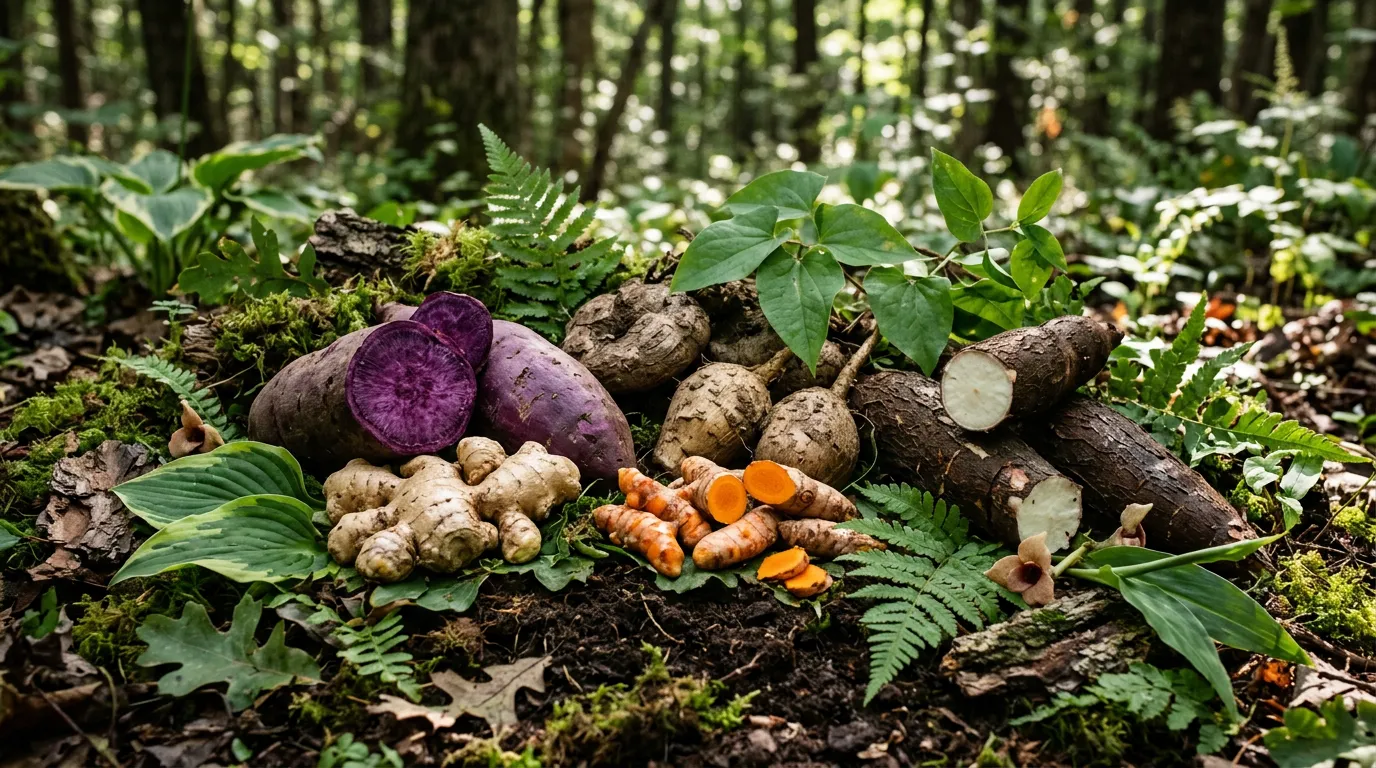
The underground world of root plants, tubers, rhizomes and bulbs represents one of the richest domains of human ethnobotanical knowledge and one of the most underappreciated chapters in the history of plant-human relationships. For most of human evolutionary history, underground plant storage organs were among the most reliable and nutritionally dense food sources available, accessible even when above-ground plant parts were seasonally scarce or destroyed by fire, drought or herbivory. The digging stick, used to excavate roots and tubers from the soil, is among the earliest documented human tools, and the knowledge of which roots were edible, which were medicinal and which were toxic formed a foundational layer of ecological knowledge in hunter-gatherer and early agricultural societies across every inhabited continent.
This knowledge was not merely practical but deeply cultural, embedded in ritual, traditional medicine systems and social structures in ways that reflect the central importance of root plants to the communities that depended on them. The yam cultivation ceremonies of Papua New Guinea, the sacred status of wild yam in West African traditional medicine, the central role of ube in Filipino celebration cuisine, the medicinal uses of Dioscorea species documented across Asia, Africa and the Americas reflect a global human relationship with underground botanicals that predates written history.
Our article on Philippine plant biodiversity explores ube as one example of how traditional plant knowledge from a biodiversity-rich archipelago is now reaching global audiences, a process that raises important questions about the conservation of both the plants and the cultural knowledge systems that have sustained them.
The Dioscorea genus : the botanical family that fed the world
The genus Dioscorea, the true yams, contains approximately 870 species distributed across tropical and subtropical regions of Africa, Asia, the Americas and the Pacific. This botanical diversity reflects the extraordinary success of the yam growth form, with its underground storage organ adapted to survive seasonal drought and fire, and the multiple independent domestication events through which different human cultures in different parts of the world selected wild Dioscorea species for cultivation over the past ten thousand years.
Dioscorea rotundata and Dioscorea cayenensis, the white and yellow Guinea yams, are the dominant cultivated species in West Africa, where yam cultivation is a cultural cornerstone of agricultural societies across Nigeria, Ghana, Benin and Côte d’Ivoire. The West African yam belt, stretching across the forest-savanna transition zone, produces over 90% of global yam output and supports food systems and cultural practices including new yam festivals that mark the seasonal harvest with ritual significance that extends far beyond agricultural necessity.
Dioscorea alata, the greater yam or water yam, is the most widely distributed cultivated yam species globally, with cultivation extending from Southeast Asia through the Pacific islands to the Caribbean and parts of Africa and South America. Within this species, the Philippine ube varieties represent a particularly distinctive subset selected for their extraordinary anthocyanin content and the resulting purple colour, characteristics that are absent or much less pronounced in Dioscorea alata varieties from other regions.
Dioscorea villosa, the wild yam of eastern North America, occupies a different category in the ethnobotanical record as a medicinal plant rather than a food staple. Its use by various Native American nations for pain relief, menstrual support and digestive complaints, and its later adoption by nineteenth century American botanical medicine practitioners, led to the identification of diosgenin, a steroidal saponin that became the starting material for the first industrial synthesis of progesterone and cortisone in the 1940s, connecting traditional plant knowledge directly to the development of modern steroid pharmacology.
Wild yam in traditional medicine systems across continents
The medicinal use of Dioscorea species spans multiple independent traditional medicine systems whose knowledge of these plants developed without contact with each other, suggesting either convergent discovery of genuine pharmacological activity or parallel recognition of the plants’ nutritional and physiological effects.
In traditional Chinese medicine, several Dioscorea species are included in the classical pharmacopoeia. Dioscorea opposita, known as shān yào or Chinese yam, is classified as a tonic herb that strengthens the spleen and stomach, nourishes the lungs and kidneys, and is used for conditions ranging from digestive weakness to fatigue and reproductive health. It appears in numerous classical formulas including Liu Wei Di Huang Wan, one of the most widely used tonics in traditional Chinese medicine, whose six ingredient formula has been in continuous use for over a thousand years.
In Ayurvedic medicine, Dioscorea bulbifera, the air potato, and related species are used in preparations for respiratory conditions, digestive support and as general tonics. The Ayurvedic classification of these plants as rasayana, rejuvenating tonics that support longevity and vitality, reflects the recognition in this system of their nutritional density and their effects on energy and digestive function.
West African traditional medicine makes extensive use of wild Dioscorea species for pain management, fever reduction and gynaecological complaints. The overlap between these traditional uses and the pharmacological activity of diosgenin and other steroidal saponins identified in these plants is one of the more compelling examples of traditional medicine knowledge anticipating pharmacological discovery in the ethnobotanical literature.
The conservation of traditional root plant knowledge
The ethnobotanical knowledge systems that have sustained human understanding of medicinal root plants for thousands of years face threats that parallel and in some cases exceed the threats to the plants themselves. The transmission of traditional plant knowledge through oral tradition, apprenticeship and community practice is disrupted by urbanisation, language loss, the replacement of traditional medicine by biomedical systems and the breakdown of the intergenerational transmission structures through which this knowledge has historically been maintained.
Ethnobotanical documentation projects, which record traditional plant knowledge through interviews with traditional practitioners and community members, represent the primary tool for preserving this knowledge before it is lost. The challenge is the sheer scale of what remains undocumented: estimates suggest that only a small fraction of the traditional plant knowledge held by indigenous and local communities globally has been formally recorded, and the pace of knowledge loss through the death of traditional practitioners without successors is accelerating.
The Convention on Biological Diversity and its Nagoya Protocol attempt to address the intersection of plant knowledge, plant genetic resources and intellectual property through frameworks that recognise the rights of local communities over the knowledge and biological resources of their territories. These frameworks are imperfect and unevenly implemented, but they represent an acknowledgment that the conservation of botanical diversity and the conservation of the cultural knowledge systems that have catalogued and utilised that diversity for millennia are inseparable challenges.